


What Did We Ever Do Without AI?
The question sounds innocent. But it carries something heavier underneath. On currents, tools, direction, and the person holding them.
There are moments when someone says it out loud: "What did we ever do without this?" Half amazed, half genuinely puzzled. The question sounds innocent. But it carries something heavier underneath.
Because you can only ask it if you lived before. You never notice when something works its way into the fabric of your life. It doesn't announce itself. One morning you wake up and it's already there, already essential. You ask the question looking backward. And without realizing it, you've just registered something quietly: this crossed a line it can't uncross.
The current doesn't ask permission
GPS, the smartphone, the internet, online banking, streaming. Nobody sat down and decided "I'm going to build my life around this." A friend joined, then another, then everyone was there. The current took you. You didn't choose the current.
And this goes well beyond technology. Women staying home was the norm, not the exception. The language of psychology, "setting boundaries," "trauma," "burnout," entered everyday life remarkably recently. What did people feel before those words existed? How did they describe it? A smoke-free indoor space feels obvious today, yet thirty years ago people lit up on planes, in hospitals, in offices.
Every era produces its own current. And inside that current, two people can exist at the same time: one drifting, one aware. Even the aware one is usually still inside it, because opting out carries its own costs now.
What takes you away from yourself
The current only works in a vacuum.
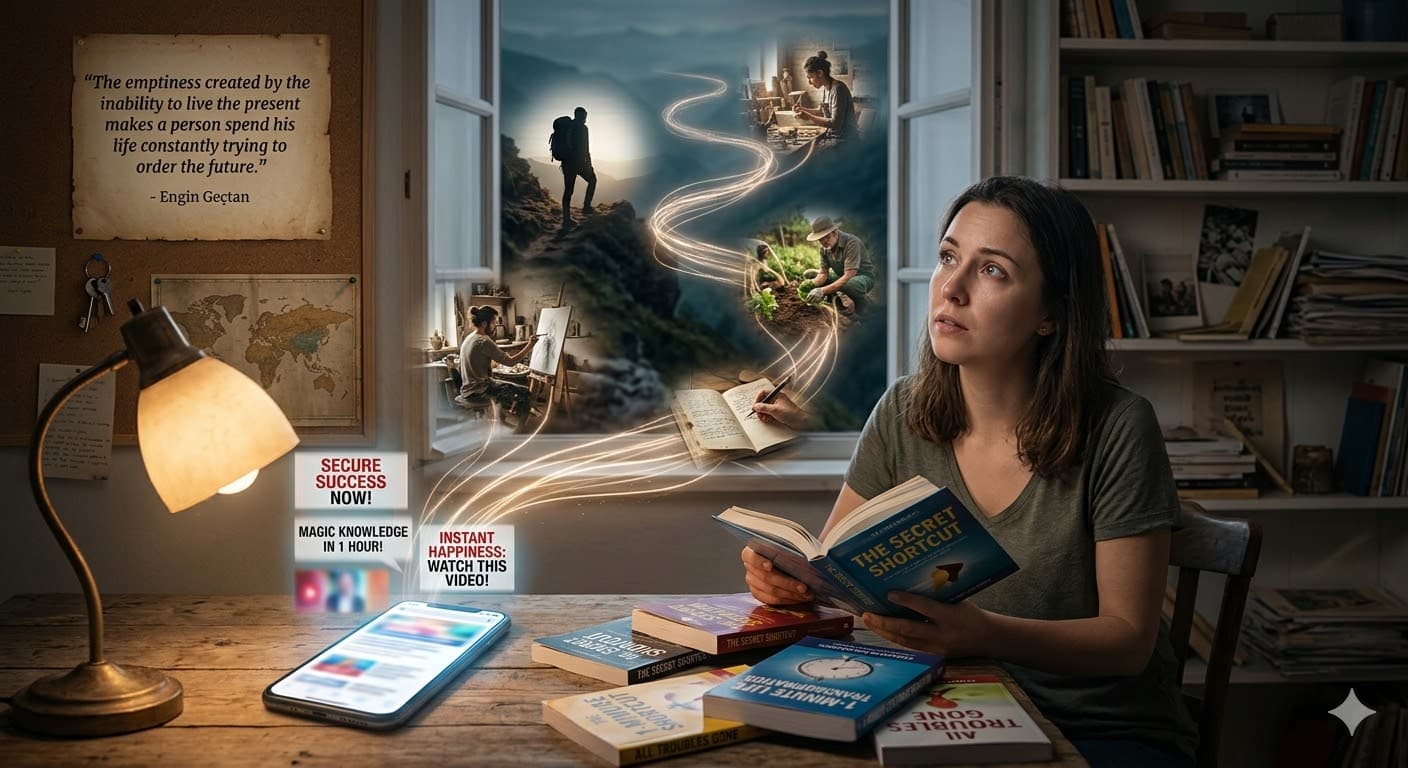
Someone who knows who they are, who can tell the difference between what comes from within and what's being pushed from outside, is much harder to carry off. But knowing yourself is getting harder. Because most of these tools are built precisely to fill that vacuum. They pull out your phone when you're bored, keep you scrolling when you feel alone, and make sure the silence where "who am I, what do I want?" might surface never actually arrives.
They eliminate that silence. That stillness. That discomfort of having nothing to do. And here's the thing: you were the same person before any of this existed. The difference is you weren't paying attention. Someone who isn't paying attention can't set a direction, can't make something a tool. And so the thing takes over instead.
The same technology, the same current, becomes something completely different in two different people's hands. For one it's a tool. For the other, it's in charge. The difference isn't in the technology. It's in how settled the person is within themselves.
A powerful tool in a directionless hand
Never in history has so much capability sat in an ordinary person's hands. And yet, at exactly the same moment, the question that would make any of it meaningful is being asked less and less. The tools got bigger. Maybe the people using them got smaller.
Without direction, energy doesn't produce work. Force exists but nothing moves. Worse than nothing, actually, because that energy goes somewhere, time passes, and nothing meaningful is left behind. Noise doesn't just steal your hours. It drowns out the quieter signal. That small internal voice saying "this is what I actually want to do" becomes inaudible. And after a while, the noise starts to feel normal. When silence comes, it's uncomfortable. The instinct is to fill it immediately. But that discomfort is precisely where something real could begin.
The AI wave is maybe the most striking example of this, and it's happening right now. Everyone is talking about it, trying it, posting about it. But how many people have stopped to ask: "What am I actually trying to do, and how would this help me get there?" Most usage is directionless, driven by curiosity or crowd pressure. Things get generated, shared, forgotten. Zero return. Often negative.
For someone who knows what they want, the same tool is genuinely transformative. Speed compounds when you have direction. Access to information matters when you know what you're looking for.
The question that never changed
The tools of every era change. The currents change. But "who are you and what do you want?" never does.
Maybe the most important skill of this age isn't technical. It's the ability to sit with yourself, to tolerate stillness, to ask "what do I actually want?" and wait for an honest answer.
Without that, even the most powerful tool will take you somewhere faster than you would have gone on your own. Just not necessarily where you meant to go.
What you did before AI is what you'll do with it
If someone is living without direction, chasing scattered small tasks, never trying to build anything of substance from what they've gathered, AI will not change that picture. It can't.
Because AI is a multiplier. Meaning: if there's nothing inside, no direction, no purpose, no real ambition, it doesn't matter how powerful the tool is. It can't fill what isn't there. Zero times anything is still zero.
But the reverse is equally true. For someone with clear goals, someone who knows what they're after and is genuinely trying to build something, AI is real leverage. In their hands, the same tool compounds, deepens, opens up. Because there's something to multiply.
The person without that foundation will do tomorrow what they do today, just a little faster and a little louder. They'll run a few prompts, generate a few things, share a few outputs. None of it will land anywhere. Because there's nowhere they're trying to land. Because the question "what am I actually trying to do?" was never asked.
Understanding what AI is actually capable of requires the same foundation. Without it, this tool becomes just another source of noise, like everything else. You think you're using it. You're just consuming it. Your time, your attention, your energy.
For someone who doesn't know themselves, who doesn't know what they want, even the most remarkable tool is a blind force. Without a steady hand pointing it somewhere, there's no telling where it goes.
The tool is ready. The question is whether you are.


Comments (0)
No comments yet. Be the first to share your thoughts!