

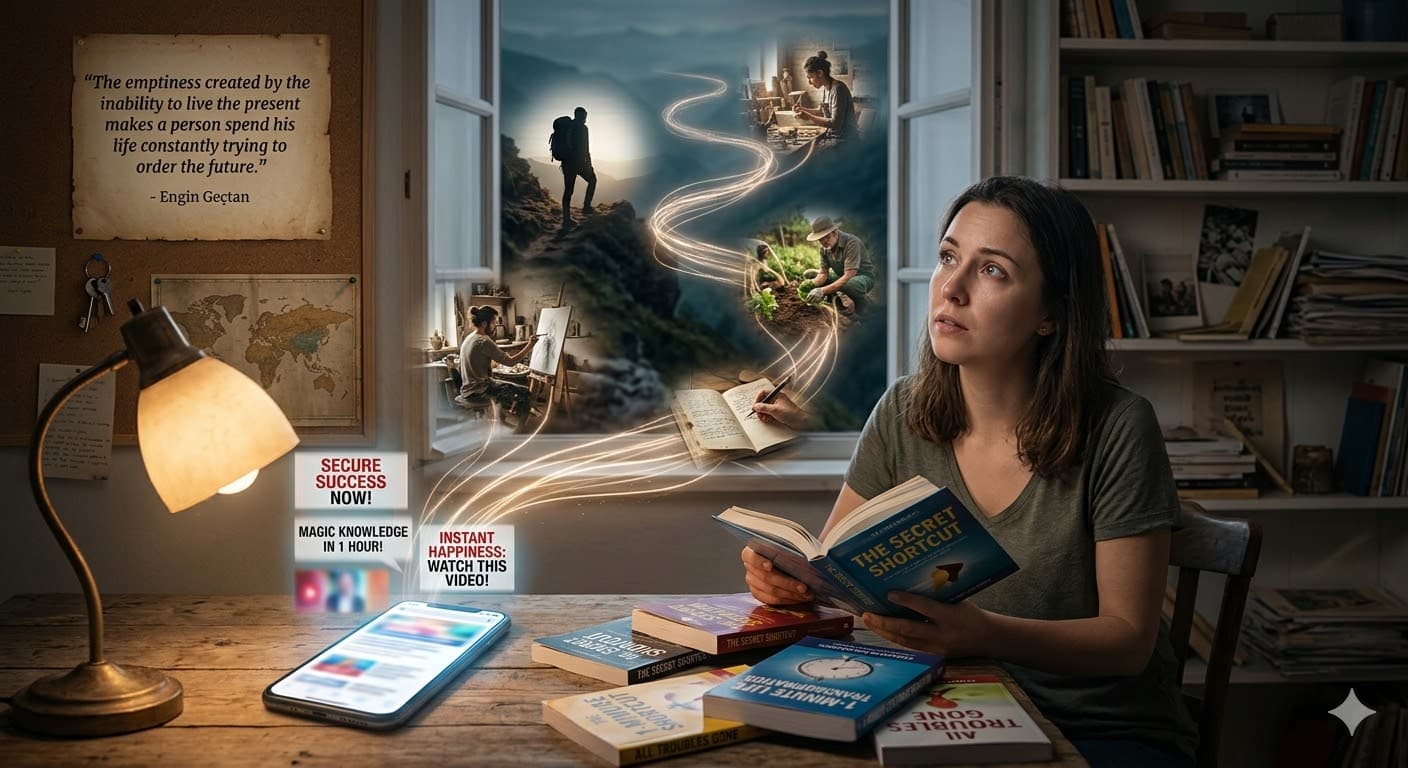
The Price of the Knowledge That Will Change Our Lives
Works that promise to change your life with one video or one book are multiplying fast. But can the price of truly changing your life be that cheap?
The Price of the Knowledge That Will Change Our Lives
The emptiness created by the inability to live the present makes a person spend his life constantly trying to order the future.
—Engin Geçtan
Is it possible to learn a piece of information within a minute or an hour that will radically change the course of our lives, allowing us to obtain what we want by a shortcut? Have you ever encountered such a magical piece of knowledge—a miracle video, a unique book, a wise person—that marked a turning point in your life?
Works that promise exactly this have been multiplying rapidly. They begin with phrases like “If you read this,” “If you watch this,” “If you do this,” and end with “your life will change,” “all your troubles will end,” “you will obtain whatever you want.” How easy, how simple—and how cheap! Can the price of changing your life truly be this easy and this cheap? If so many people did not believe it, such a market would never have emerged or sustained itself. It is obvious that this is a money trap, a clickbait scheme, a market product. Yet why does it attract so much attention?
The human being’s relationship with matter is a strange one. To the extent that he loses himself, he elevates matter; to the extent that he has no meaningful story to tell, he tries to fill that void with matter. When he rises materially, he falls into the delusion that he has risen in his humanity as well. When he cannot fill his mind and heart, he rushes to fill his pockets, his bags, his house—so that he may breathe in the well of dissatisfaction into which he has fallen.
We can understand the human tendency to use matter as a means of distraction. But it does not end there. Apparently, this distraction did not suffice, for we have moved one step further: even “knowledge,” which might be considered spiritual, has long since been turned into another material object among our toys. Just like the objects we accumulate and consume—many of which we do not really need—knowledge too has become a heap of information that makes no change in our lives, that merely occupies space in our memory, that spills from our mouths in seemingly wise phrases when the occasion arises. Does “knowing” have any value if it brings no new vision to our lives? If so, what kind of knowing is this? Is everyone who knows a sage?
It seems that just as human beings use and consume matter as a means of distraction, they also consume knowledge as a kind of intoxicant. If this were not the case, would not the knowledge possessed by the average person today be enough to make the world more humane and more livable?
Indeed, once a person turns away from truth and from himself, he begins to transform everything in his life—good or bad, positive or negative—into a kind of narcotic. When he begins to avoid reality, even the most precious and noble values can become mere objects of consumption, used to distract, console, and entertain himself.
In this sense, for children and adults alike, we have long been producing and consuming games, toys, and distractions. Technology is perhaps the most attractive of these. We seize whatever inventions our hands or pockets can reach and indulge in their intoxication. This has become an easy story to understand: we are putting ourselves to sleep. But the story does not end there. In fact, the real story begins precisely here. The person who realizes—in a dream—that he is being put to sleep tries to wake up, only to deepen his sleep further by entering a dream within a dream. Yet he now believes he has awakened. That dream within the dream is this:
There is a difference between possessing knowledge of something and truly knowing it. We all have knowledge of what “soil” is. But is that soil the same for a farmer, a miner, a geologist, an economist, or a politician? Does having dictionary knowledge of something mean that we truly know it? Can you learn what “motherhood” is from a sentence or a book? Clearly, we cannot claim to truly know anything that has not entered the process of our lived experience and produced a new story in our lives. At most, it becomes dry information. In the same way, sometimes even realizing that we are in a dream, recognizing that we are in an unconscious process, is not enough to awaken our consciousness. Only a kind of knowing that triggers real movement—one that enters into life and emerges with a new outcome—can awaken us from our dream. Otherwise, our journey through dreams within dreams will continue, deepening.
Although this subject is widely examined in academic literature and holds an important place in ancient teachings, it remains each person’s task to understand and bring it to a conclusion in a way that he himself can grasp. After all, we are subjected daily to a bombardment of information—an occupation of the mind. Every day, someone appears before us with ready-made formulas: “the secret of happiness,” “the secret of making money,” and so on. If I do not know what true “knowing” is, my life will turn into a battlefield filled with these random bursts of information and data that explode from screens and from people.
Let us conclude with a few simple questions. Is it enough to describe an apple to someone who has never eaten one, to show them a picture of it, for them to truly know what an apple is? Does knowing the location of America on a map mean that we know America? Is everyone who holds a driver’s license a real driver? Is every engineering graduate truly an engineer? No. It is not, it cannot be, it is impossible. Then will buying, reading, and watching the “secrets of success” and the “knowledge of happiness” make us successful and happy?
If that is so, what is the meaning of these heaps of information and confusion? How should we read, listen, observe, and watch? Of course, we should read, research, learn, and listen. But unless we make the knowledge we acquire part of our humanity and our lives, we cannot truly say that we know it. At best, we become merely “know-it-alls.” To make knowledge part of our humanity and life means to digest it with our mind, heart, and soul and to experience it in our lives. Only in this way is the “secret” understood, and only in this way is knowledge grasped.
The price of truly obtaining knowledge is to experience it. And that price is often paid through work, sacrifice, pain, loss, and hardship in our lives. When that price is paid, we become ready—and entitled—to know the knowledge that has come, is coming, or will come our way. Happiness and success are not things to be learned and known; they are the results of what we have learned and known. The idea of ordering happiness and success as if placing an order is an endless path of escape. What we purchase in such a way can only be a materialized lie.
stone: waiter, one portion of happiness, please!
scissors: buy success, get happiness free!
paper: how much if I buy in bulk?



Comments (0)
No comments yet. Be the first to share your thoughts!